
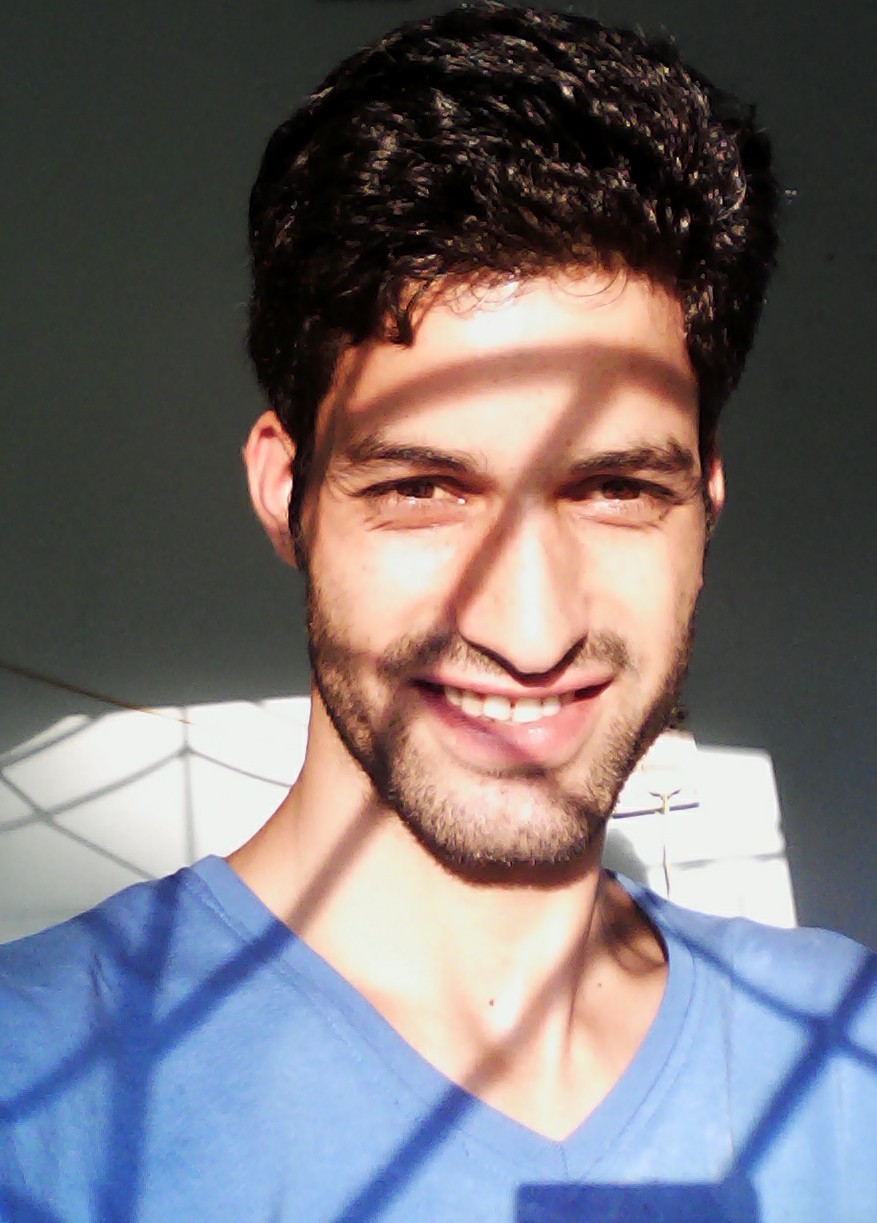
By Mohd Younus Laway
Artist | Department of Anatomy, Government Medical College Srinagar | Gold Medalist | Visva-Bharati Alumnus
There exists an ancient paradox at the heart of human civilization: while creators pass through time, their creations often outlive them. The hands that carved temples, illuminated manuscripts, painted masterpieces, and shaped civilizations have disappeared into history, yet their works continue to converse with humanity across centuries. The artist fades; the art remains. The individual becomes invisible; the creation acquires a form of immortality.
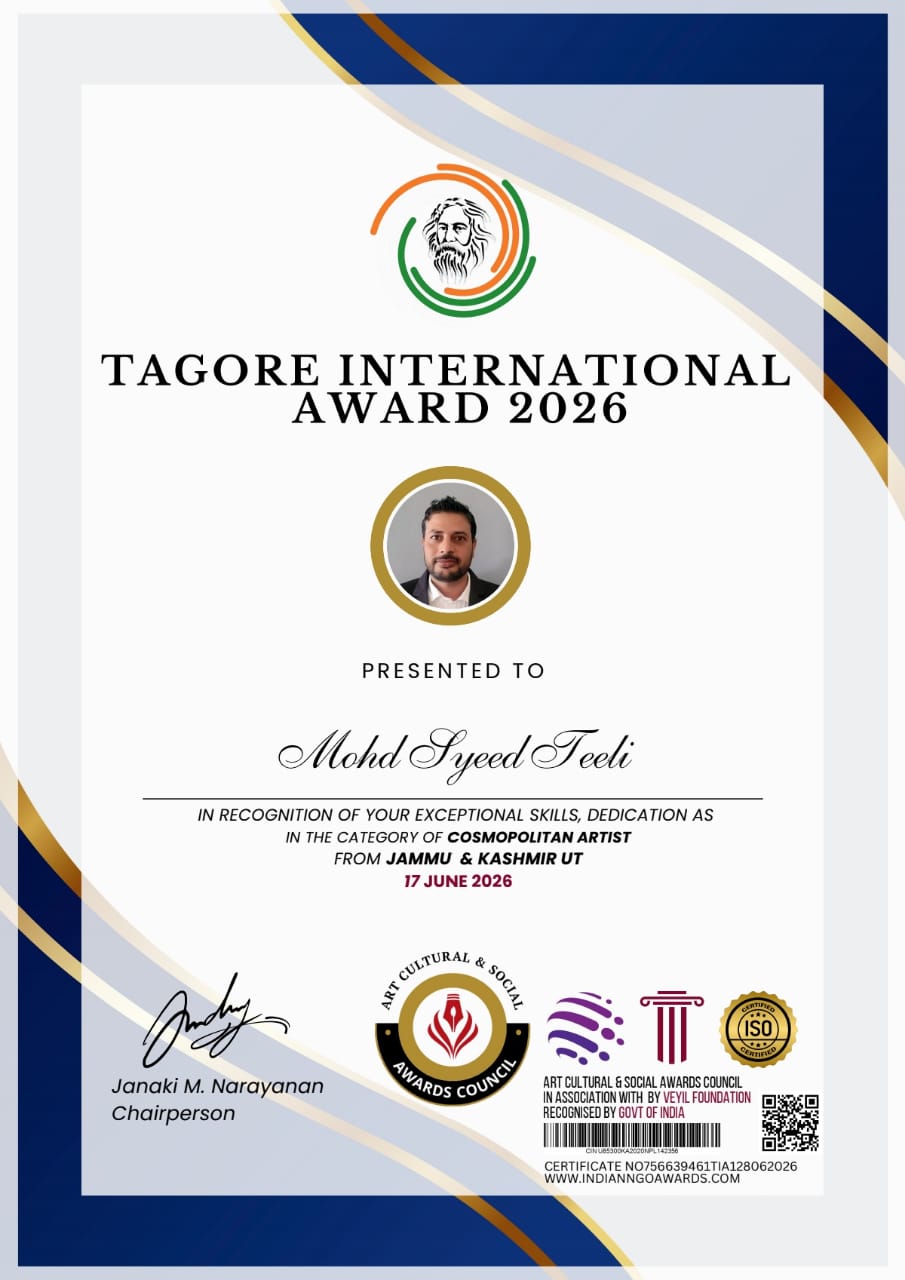
In an age increasingly dominated by visibility, publicity, and self-promotion, the artistic journey of Mohd Syeed Teeli offers a striking counter-narrative. An artist, educator, scholar, and cosmopolitan thinker, Teeli represents a philosophy in which recognition does not belong to the ego of the creator, but to the enduring life of the creation itself.
Across a decade, three remarkable episodes have unfolded in his life—three moments of honour, three public recognitions, and, remarkably, three occasions where the artist himself remained absent from the centre of attention. Together, these incidents form a symbolic narrative that invites deeper reflection on the relationship between the visible artwork and the invisible creator.
The first episode occurred on 23 February 2016 in Srinagar, when Mohd Syeed Teeli received a prestigious State Merit Award accompanied by a cash honour. It was a public acknowledgment of artistic excellence. Yet the artist himself was absent from the ceremonial gathering. The distinction reached his name, but not his physical presence. The award was celebrated; the artist remained unseen.
The second episode unfolded when one of Teeli’s original artworks was formally presented to the Honourable Lieutenant Governor of Jammu and Kashmir. The portrait entered one of the highest constitutional spaces of the Union Territory and became part of a significant public moment. Yet once again, the creator remained outside the frame. The artwork stood in the photograph; the artist did not.
The third episode emerged on 13 June 2026, during the Graduation Day ceremony of AA Academy, Kulgam. The occasion was graced by the Honourable Minister for Education, Health and Social Welfare, Ms. Sakeena Itoo, alongside the Deputy Commissioner of Kulgam, distinguished guests, educators, parents, and students.
During the ceremony, an original watercolor portrait of the Education Minister, painted by Mohd Syeed Teeli, was respectfully presented by the esteemed Chairman of AA Academy, Dr. Feroz Ahmad Padder, in the presence of Co-Chairperson Dr. Edisa Padder, the Principal and CEO, Heads of Departments, faculty members, and the wider academic community.
Yet the artist himself was not standing on the stage.
Instead, he was fulfilling his institutional responsibilities at the Peace Block, ensuring discipline, order, and the well-being of students. While his artwork occupied a place of honour before the audience, the creator remained quietly engaged in service.
Three recognitions. Three public moments. Three absences.
To many observers, such a pattern may appear coincidental. Yet philosophy teaches us that repetition often reveals meanings hidden beneath ordinary events.
When asked about this recurring absence, Teeli responded with characteristic humility and contemplation:
“Perhaps destiny has created a mysterious companionship between me and my art. Whenever my artwork reaches the stage, I often remain behind the curtain. The world searches for the artist in the photograph, but I search for myself within the soul of my creation.”
These words reveal a deeper philosophy of creation. The greatest creators do not merely seek to be seen; they seek to leave something worthy of being remembered. The true legacy of an artist is not the image of the artist standing beside the work, but the life that the work continues to live after it has left the creator’s hands.
This philosophy extends beyond the boundaries of art into the wider world of education and human knowledge. As Mohd Younus Laway beautifully reflects:
“A book does not ask whether it belongs to a library, and a colour does not ask whether it belongs to an art room. Knowledge has no borders; only institutions create them. A child’s imagination is a universe where literature, art, science, and humanity coexist. The highest purpose of education is not separation, but collaboration; not ownership, but enlightenment.”
Art, like knowledge, transcends walls and disciplines. It belongs to humanity itself.
The story of Mohd Syeed Teeli is therefore not merely a story of awards or recognition; it is a reflection on the eternal relationship between the creator and the creation—where the artist may be absent from the photograph, but remains forever present in history through the work he leaves behind.